The EME4EU project is co-funded by the European Union. The views and opinions expressed in this publication are those of the author(s) only and do not necessarily reflect those of the European Union or the Spanish Service for the Internationalisation of Education (SEPIE). Neither the European Union nor the National Agency SEPIE can be held responsible for them. -- Project Number: 2025-1-ES01-KA220-HED-000358473 --
The EME 4 EU project partnership made contacts with web sites focusing on the field of school education. The EME 4 EU project was presented to the web masters and a link to The EME 4 EU project portal was made so that those who will access the selected web sites can also access, through a direct link, the The EME 4 EU project portal.
Pixel is partner in the EME4EU project. Pixel website provides information about the project together with a direct link to the Portal. Users from Universities, Associations, Public bodies, Training Agencies, Schools, participants in the International Conferences on Education and people interested in the seminars/masters visit Pixel website (estimated visits are around 12.000 users each year). They may now learn about and benefit from the EME4EU project.
UNED is the EME4EU project coordinator. UNED website provides information about the project together with a direct link to the Portal. UNED students and teachers, other national and international universities, , Public bodies, Training Agencies, Schools, visit UNED website (estimated visits are around 210.000 users each year). They may now learn about and benefit from the EME4EU project.
The AVTIA project aims to develop new innovative content that provides lecturers in Higher Education Institutions (HEIs) with knowledge and materials in the form of open online courseware (OPC) to teach and assess inclusion in audiovisual translation/subtitling for the deaf and hard of hearing, and audio description for the blind and partially sighted; build and consolidate the required knowledge and skills of university students (including freelance translators) specializing in audiovisual translation through autonomous learning, preparing them for current labor market needs; generate attitude change and raise awareness among HEIs and stakeholders regarding the disparity in the range of inclusion services provided in different EU member states and the obligation to ensure access to public information for people with disabilities within national legislation. The website of the project reports a link to EME4EU project from the Press and Media section
The CO-THINK project has the aim to develop a functional STEAM approach for pre-service teacher training with a gender perspective and to foster competence in teaching computational thinking and to supports the digital transition by integrating computational thinking into STEM teaching. The website of the project reports a link to the EME4EU project from the Press and Media section
The DAI project has the aim to improve Italian as a foreign language instruction through the integration of AI. Its core objectives are to provide students with a personalized, AI-based training package; equip teachers with the digital and AI skills needed for effective integration of these technologies; offer a comprehensive resource library for both teachers and learners, gather a learner corpus from the online course for research purposes.This initiative seeks to transform teaching practices by leveraging AI's potential for tailored education. The website of the project reports a link to the EME4EU project from the Press and Media section.
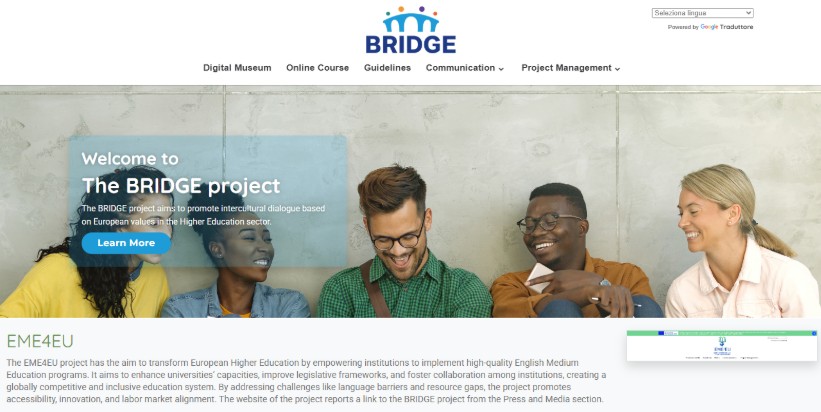
The BRIDGE project aims to promote intercultural dialogue based on European values in the Higher Education sector.The specific objectives are to raise awareness on social challenges in HEIs that affect intercultural dialogue by highlighting inspiring practices and offering interactive teaching resources through a digital pedagogical museum, to provide innovative and specialized university education by developing microcredentials that train for intercultural competencies to address social challenges and to support Inclusive University Governance, helping institutions integrate diversity, human rights, and equality into policies. By the end of the project, at least six universities will have piloted or integrated these frameworks. The website of the project reports a link to the BRIDGE project from the Press and Media section.
The BREATH project aims to develop rehabilitation programs and plans, improve undergraduate and post-graduate education, improve patient education, educate patient's families and patients organizations, and improve patients quality of life. The project also aims to improve the skills of the following stakeholders: university of physiotherapy/ physical activity /sports /nursing students that need to acquire the professional skills and competencies required of today’s patients with chronic respiratory disease; it also helps physiotherapy/ physical activity /sports /nursing professionals who wish to specialize in a particular area. The website of the project reports a link to the EME4EU project from the Press and Media section.
The Innovative Skills for Nurses (ISN) project has the aim to develop innovative nursing student-centered curricula in order to better meet their learning needs and to reduce skills mismatches for the training of Specialist Nurse (SN) and the Advanced Practice Nurse (APN) in a wide-spectrum of specialties with crucial impact on healthcare systems which will be extremely relevant for the labor market and for the wider society. The specific aims of the project are to develop an innovative Curriculum to be implemented in all partner universities for the training of Specialist Nurses (SN) and Advanced Practice Nurses (APN), to provide trainers and lecturers of in-service and student nurses with innovative digital teaching skills and methods and to create an online Repository of digital and virtual reality based scenarios and diagnostic challenges to be used as teaching and learning sources to qualify nurses. The website of the project reports a link to the EME4EU project from the Press and Media section.
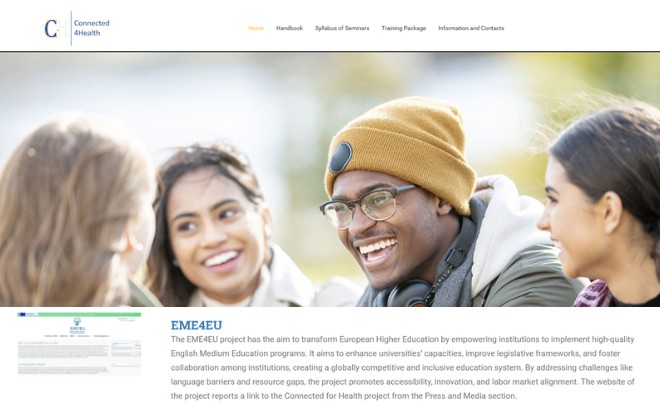
The Connected For Health project has the aim to provide lecturers/ trainers in universities with skills, knowledge, methods and tools to explore and address teaching/training obesity and EDs trough a trans-disciplinary approach, help residents and students consolidate their knowledge and skills in approaching patiences with obesity and eating disorders, support specialists in different medical fields to acquire new trans-disciplinary knowledge and skills to deal with these patiences. The website of the project reports a link to the EME4EU project from the Press and Media section.
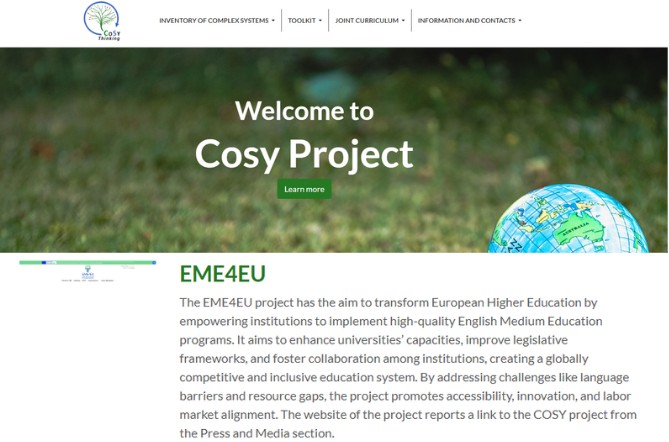
The Cosy-thinking project identifies three main specific objectives: to strengthen the collaboration among academic institutions provide them with a clearer picture of the range of opportunities between the universal and the particular; to provide academic lecturers and managerial staff with knowledge, skills and tools for adapting their educational activities with a specific focus on sustainable development and to provide undergraduate students with competences on complex systems thinking as a basis for sustainability action and make them employable in organizations interested to meet the sustainable development goals. The website of the project reports a link to the EME4EU project from the Press and Media section.
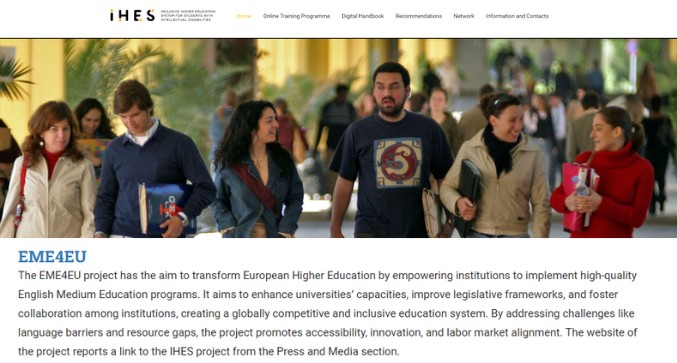
The purposes of IHES project is to develop and implement online programme on inclusion and independent living for people with intellectual disabilities in universities; to design and pilot a methodology to support inclusion of students with intellectual disabilities in the Higher Education (HE) systems; and to develop a set of recommendations to university policy and decision makers at HE level on how to promote inclusion of people with intellectual disabilities. The website of the project reports a link to the EME4EU project from the Press and Media section.
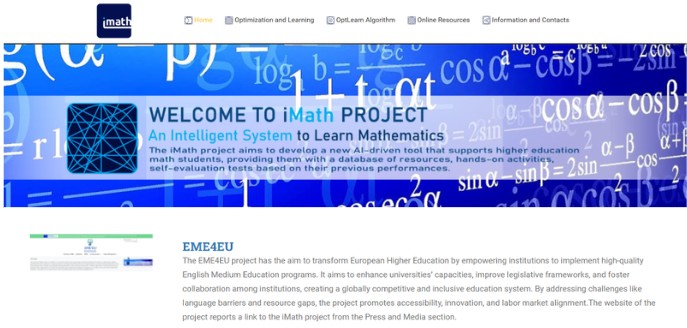
The purpose of iMath portal is to develop a new AI-driven tool that will support higher education students with respect to mathematics subjects, providing them with a database of resources, hands-on activities and self-evaluation tests, brought together in an online dynamical platform that will help and advise them through a personalized learning path based on their previous performances. Therefore, iMath aims to add value, lowering the perception that mathematics is too hard to be understood and contributing to mitigate the dropping out of students due to perceived mathematics obstacles. The website of the project reports a link to the iMath project from the Press and Media section.
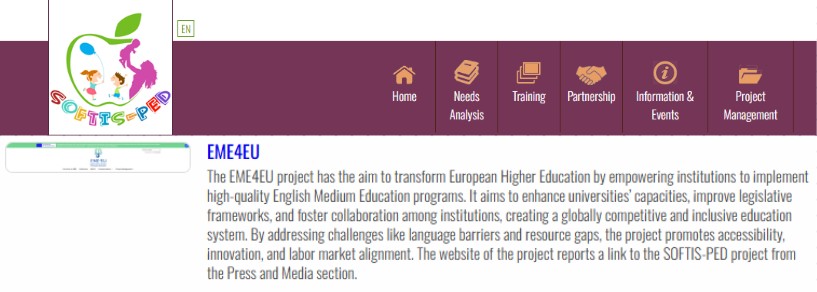
The Softis-Ped project aims to identify the most important soft skills in the field of paediatrics, match them with the best teaching methods and strategies, and elaborate guidelines and materials for training the paediatricians’ trainers. The website of the project reports a link to the EME4EU project from the Press and Media section.
The VIW project aims to answer to the need of students of developing better knowledge and awareness toward the theme of woman migrations considering the interrelation of factors such as: gender, status, ethnicity, age, religion, origin, political opinion. The website of the project reports a link to the EME4EU project from the Press and Media section.
The purposes of STEAM-Active project are to improve the capacity of the higher education educational offer in engineering of new learning and teaching methods; to tackle engineering student underachievement and gender inequality; to provide university lecturers with STEAM based methodological approaches and teaching tools; and to provide universities with consistent, re-usable and up-scalable teaching-Learning sequences based on the STEAM methods. The website of the project reports a link to the EME4EU project from the Press and Media section.
The ALCMAEON project aims to innovate the teaching of medical history with a new educational approach, the object-based learning, and to work in a better integration of historical, ethical and psychosocial components of medical humanities.It represents an alternative model of medical history provision and an attempt to overcome the gap between clinical practice and historical perspective of medical humanities, through the representation of the historical scenarios and the integration of historical evidences in specific educational contents.The ALCMAEON project will collect audio-visual material to digitalize the available collections of medical museum in Italy, Spain, Greece, United Kingdom and Romania, in the attempt to promote the different traditions characterizing European medical history and bring the medical museums in the classroom. The website of the project reports a link to the ALCMAEON project from the Press and Media section.
The Pro-Telde project aims to provide the target groups with basics skills to exploit digital solutions for teaching. Furthermore, and more importantly, the project aims to provide the target groups of the skills and competences to identify and select existing open digital sources that can be used for teaching business and economics subjects, make full use of all the potentialities of digital education and technology-enhanced learning (TEL) as an integration or alternative to traditional teaching, and finally help them to create their own digital teaching sources in the field of business and economics. The project will also provide South African HEIs and TVET lecturers with a Repository of validated TEL and digital Teaching Sources in the field of business and economics. The website of the project reports a link to the EME4EU project from the Press and Media section.
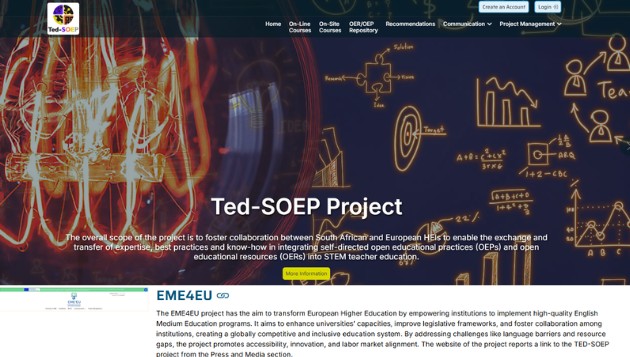
The overall scope of the Ted-SOEP project is to foster collaboration between South African and European HEIs to enable the exchange and transfer of expertise, best practices and know-how in integrating self-directed open educational practices (OEPs) and open educational resources (OERs) into STEM teacher education. The specific objectives of the project are to enhance the skills, knowledge and capacities of lecturers and teacher-students in STEM education in South African Higher Education, on making full, aware and effective use of Self-Directed Learning (SDL) based methods, Open Educational Resources (OER) and Open Educational Practices (OEP) in their educational offer and teaching approaches; then to establish a sustainable environment for the sharing, adaptation and creation of self-directed teaching resources OER and OEP based for STEM teacher-students and lecturers in STEM fields; finally to provide a set of methodological and practical steps for Higher Education Institutions and policy makers to promote the adoption of self-directed based OEPs (Open Educational Practices) and OERs (Open Educational Resources) tailored for the South African context. The website of the project reports a link to the EME4EU project from the Press and Media section.
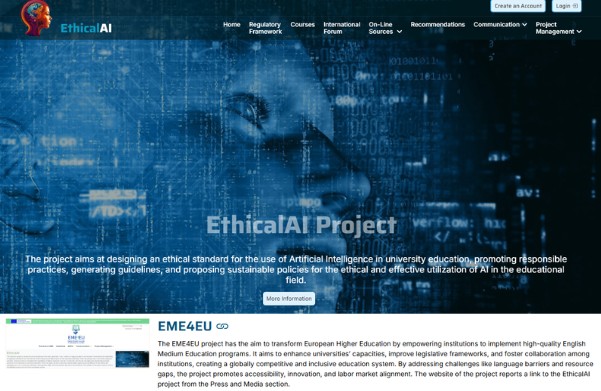
The Ethical-AI project's primary focus encompasses three main objectives. First, it seeks to engage academic and research communities in establishing a regulatory framework and international forums that promote discussions on best practices and ethical needs regarding AI use in university academic activities. Second, it aims to strengthen the capabilities of higher education lecturers in Costa Rica and Peru in managing and implementing ethical practices for AI utilization in university education. Third, the project strives to develop comprehensive global recommendations for the ethical and adaptable use of AI in university education, ensuring these align with international regulations and standards. The website of the project reports a link to the EME4EU project from the Press and Media section.
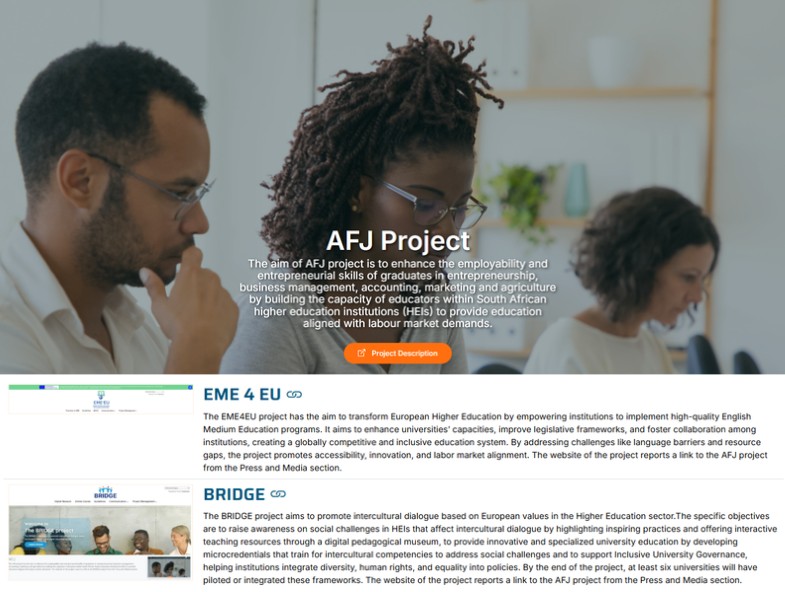
The AFJ project has the aim to enhance the employability and entrepreneurial skills of graduates in entrepreneurship, business management, accounting, marketing and agriculture by building the capacity of educators within South African higher education institutions (HEIs) to provide education aligned with labour market demands. The website of the project reports a link to the EME4EU project from the Press and Media section.
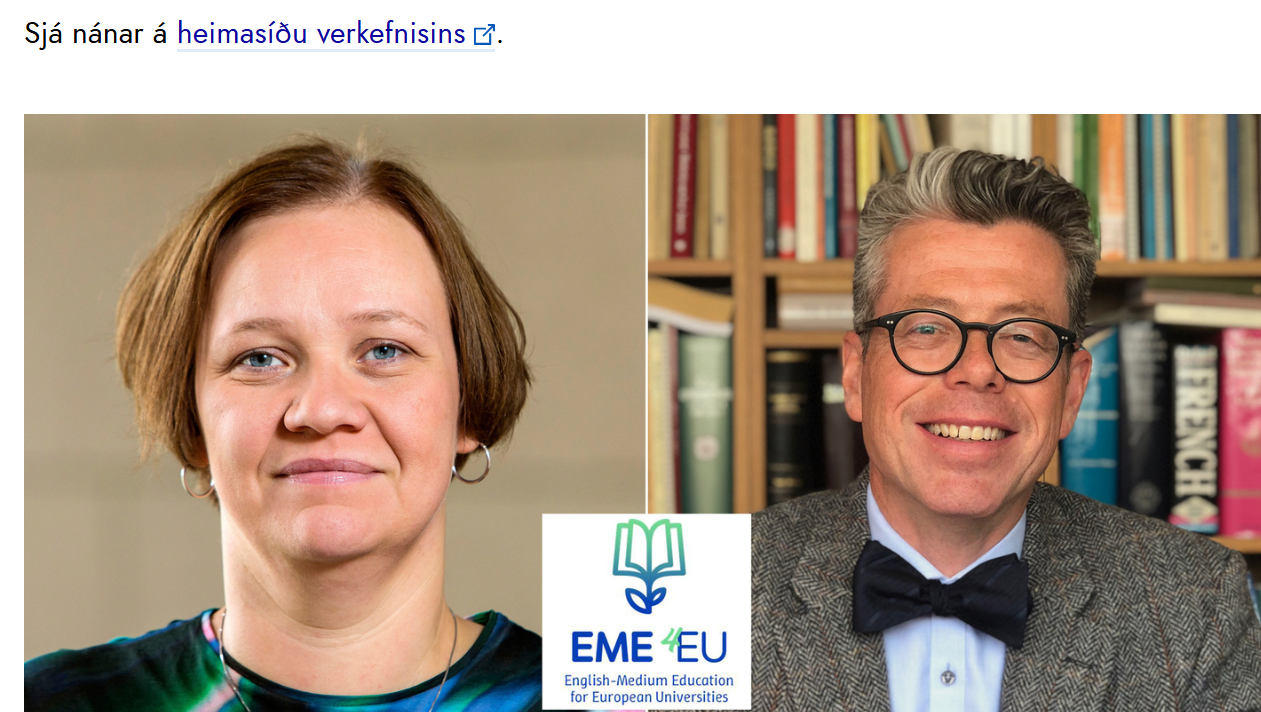
Verkefnið „Enska sem miðlunarmál á háskólastigi í Evrópu“ eða „English-Medium Education for European Universities“ (EME4EU) er samstarfsverkefni sjö aðila frá sjö löndum og styrkt af Erasmus+ áætluninni. Verkefnið sem er til þriggja ára fór af stað í lok síðasta árs og miðar að því að styðja notkun ensku sem miðlunarmáls við kennslu nemenda sem ekki hafa ensku sem móðurmál (English-Medium Education, EME) í háskólum í Evrópu. Það er gert með því að greina árangursríkar kennsluaðferðir og auka vitund um gildi kennslu á ensku í alþjóðlegu háskólastarfi um leið og staða heimamálsins er tryggð. Verkefnið varðar bæði háskólakennara og -nemendur sem og stjórnendur í háskólum. Meðal afurða úr verkefninu verður samanburður á stefnum í ýmsum löndum er varðar notkun ensku sem miðlunarmáls, safn dæma um góða kennsluhætti, leiðbeiningar fyrir stjórnendur um notkun ensku sem miðlunarmáls og fræðsluefni fyrir kennara. Haraldur Bernharðsson, prófessor við Íslensku- og menningardeild, og Rannveig Sverrisdóttir, lektor við sömu deild, eru fulltrúar Háskóla Íslands í verkefninu. Sjá nánar á heimasíðu verkefnisins.
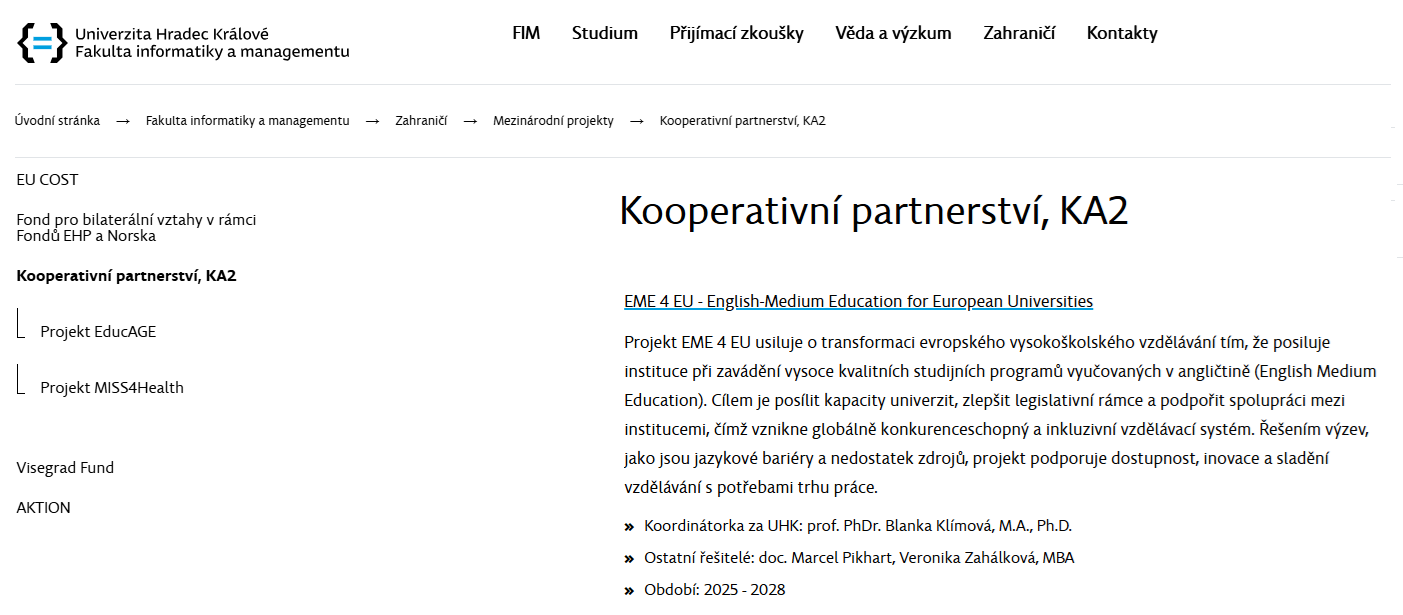
The EME 4 EU project aims to transform European higher education by supporting institutions in the implementation of high-quality study programs taught in English (English Medium Education). The goal is to strengthen university capacities, improve legislative frameworks, and foster collaboration among institutions, thereby creating a globally competitive and inclusive education system. By addressing challenges such as language barriers and resource shortages, the project promotes accessibility, innovation, and the alignment of education with labor market needs.
Το έργο EME 4 EU επιδιώκει να μεταμορφώσει την Ευρωπαϊκή Ανώτατη Εκπαίδευση, ενδυναμώνοντας τα ιδρύματα να εφαρμόσουν υψηλής ποιότητας προγράμματα εκπαίδευσης στην αγγλική γλώσσα. Στόχος του είναι η ενίσχυση των ικανοτήτων των πανεπιστημίων, η βελτίωση των νομοθετικών πλαισίων και η ενίσχυση της συνεργασίας μεταξύ των ιδρυμάτων, δημιουργώντας ένα παγκοσμίως ανταγωνιστικό και χωρίς αποκλεισμούς εκπαιδευτικό σύστημα. Αντιμετωπίζοντας προκλήσεις όπως τα γλωσσικά εμπόδια και τα κενά πόρων, το έργο προωθεί την προσβασιμότητα, την καινοτομία και την ευθυγράμμιση της αγοράς εργασίας. Οι συγκεκριμένοι στόχοι που επιθυμεί να επιτύχει το EME 4 EU είναι: Προσδιορισμός πολιτικών και πρακτικών για την εφαρμογή της Ανώτατης Εκπαίδευσης σε όλη την Ευρώπη. Ευαισθητοποίηση των υπευθύνων λήψης αποφάσεων, των εκπαιδευτικών και των φοιτητών σχετικά με τη σημασία της Ανώτατης Εκπαίδευσης στη διεθνοποίηση των ευρωπαϊκών πανεπιστημίων. Εξοπλισμός των πανεπιστημιακών καθηγητών και των υπευθύνων χάραξης πολιτικής με τις δεξιότητες για την εφαρμογή και αξιοποίηση των δυνατοτήτων της Εκπαίδευσης για Ανώτερη Εκπαίδευση (EME).
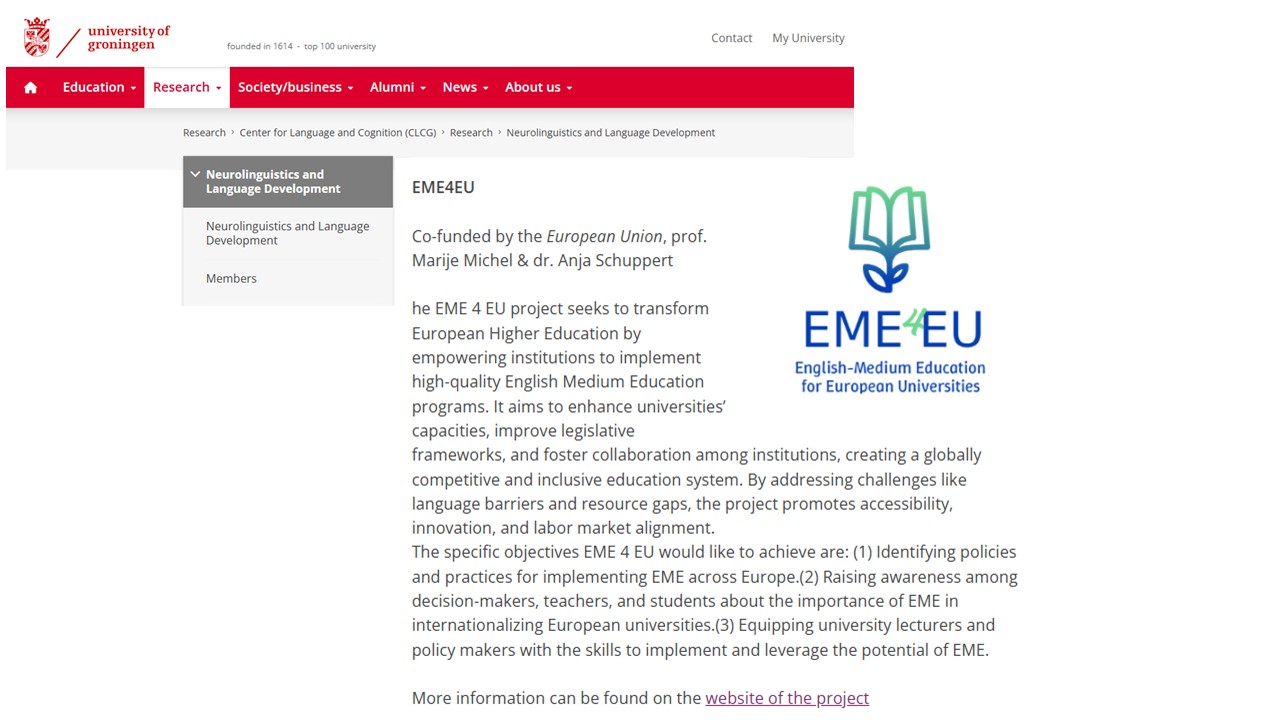
EME4EU - English Medium Education for European Universities. The EME 4 EU project seeks to transform European Higher Education by empowering institutions to implement high-quality English Medium Education programs. With Anja Schüppert - in collaboration with Universidad Nacional de Educación a Distancia Madrid, Spain; University of Hradec Králové Hradec Králové, Czech Republic; University of Crete Rethymno, Crete, Greece; Pixel, Florence, Italy; University of Iceland Reykjavík, Iceland; Dicle University, Diyarbakır, Türkiye Co-funded by the European Union, Project Number: 2025-1-ES01-KA220-HED-000358473. Time line: 2025-2028.
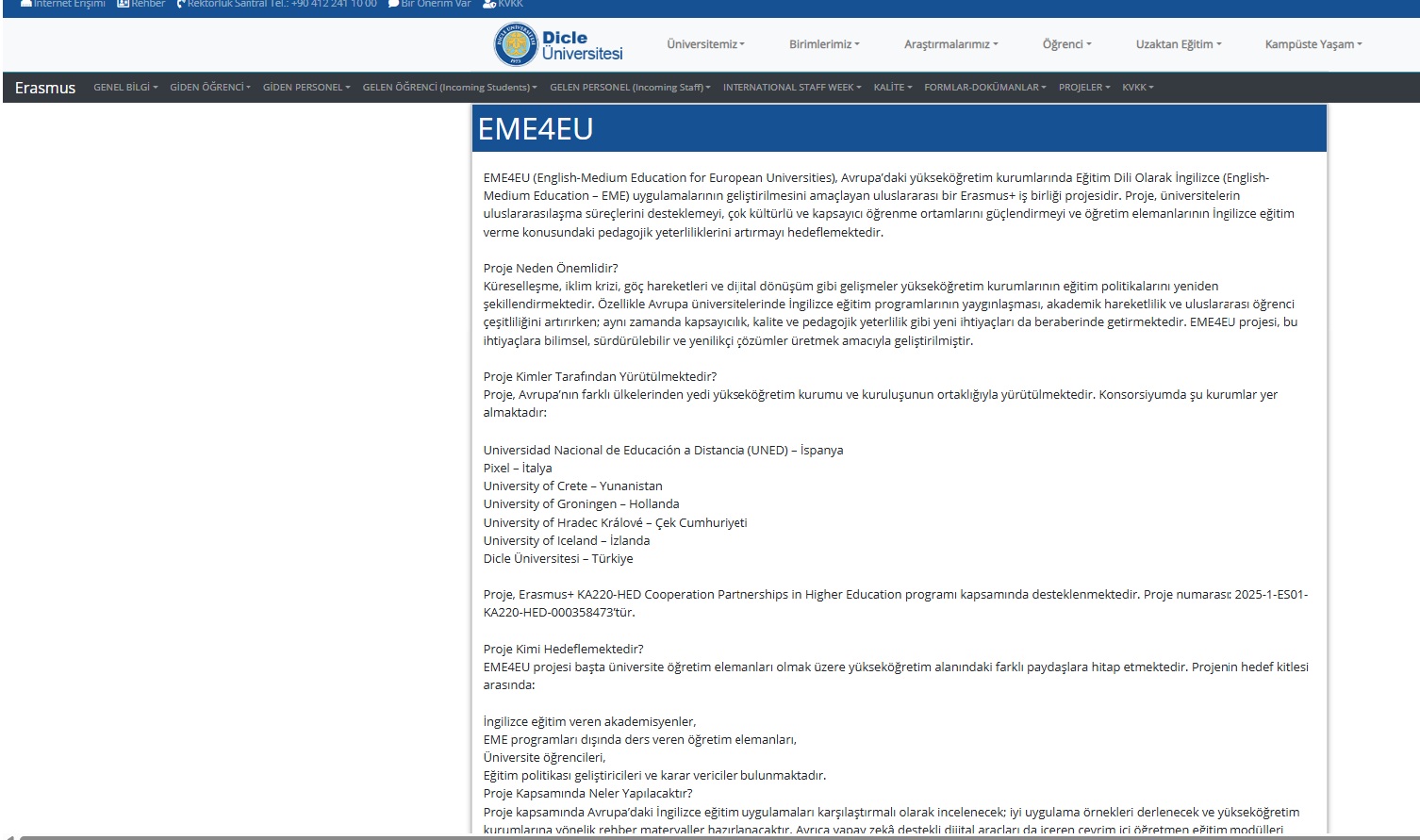
EME4EU (English-Medium Education for European Universities), Avrupa’daki yükseköğretim kurumlarında Eğitim Dili Olarak İngilizce (English-Medium Education – EME) uygulamalarının geliştirilmesini amaçlayan uluslararası bir Erasmus+ iş birliği projesidir. Proje, üniversitelerin uluslararasılaşma süreçlerini desteklemeyi, çok kültürlü ve kapsayıcı öğrenme ortamlarını güçlendirmeyi ve öğretim elemanlarının İngilizce eğitim verme konusundaki pedagojik yeterliliklerini artırmayı hedeflemektedir. Proje Neden Önemlidir? Küreselleşme, iklim krizi, göç hareketleri ve dijital dönüşüm gibi gelişmeler yükseköğretim kurumlarının eğitim politikalarını yeniden şekillendirmektedir. Özellikle Avrupa üniversitelerinde İngilizce eğitim programlarının yaygınlaşması, akademik hareketlilik ve uluslararası öğrenci çeşitliliğini artırırken; aynı zamanda kapsayıcılık, kalite ve pedagojik yeterlilik gibi yeni ihtiyaçları da beraberinde getirmektedir. EME4EU projesi, bu ihtiyaçlara bilimsel, sürdürülebilir ve yenilikçi çözümler üretmek amacıyla geliştirilmiştir. Proje Kimler Tarafından Yürütülmektedir? Proje, Avrupa’nın farklı ülkelerinden yedi yükseköğretim kurumu ve kuruluşunun ortaklığıyla yürütülmektedir. Konsorsiyumda şu kurumlar yer almaktadır: Universidad Nacional de Educación a Distancia (UNED) – İspanya Pixel – İtalya University of Crete – Yunanistan University of Groningen – Hollanda University of Hradec Králové – Çek Cumhuriyeti University of Iceland – İzlanda Dicle Üniversitesi – Türkiye Proje, Erasmus+ KA220-HED Cooperation Partnerships in Higher Education programı kapsamında desteklenmektedir. Proje numarası: 2025-1-ES01-KA220-HED-000358473’tür. Proje Kimi Hedeflemektedir? EME4EU projesi başta üniversite öğretim elemanları olmak üzere yükseköğretim alanındaki farklı paydaşlara hitap etmektedir. Projenin hedef kitlesi arasında: İngilizce eğitim veren akademisyenler, EME programları dışında ders veren öğretim elemanları, Üniversite öğrencileri, Eğitim politikası geliştiricileri ve karar vericiler bulunmaktadır. Proje Kapsamında Neler Yapılacaktır? Proje kapsamında Avrupa’daki İngilizce eğitim uygulamaları karşılaştırmalı olarak incelenecek; iyi uygulama örnekleri derlenecek ve yükseköğretim kurumlarına yönelik rehber materyaller hazırlanacaktır. Ayrıca yapay zekâ destekli dijital araçları da içeren çevrim içi öğretmen eğitim modülleri geliştirilecektir. Projenin temel çıktıları arasında şunlar yer almaktadır: Avrupa’daki EME politikalarına ilişkin karşılaştırmalı analiz raporları, İyi uygulama örnekleri havuzu, Üniversiteler için politika ve uygulama rehberleri, Öğretim elemanlarına yönelik çevrim içi eğitim paketleri. Proje Ne Zaman ve Nerede Yürütülmektedir? EME4EU projesi Avrupa çapında yürütülen uluslararası bir iş birliği projesidir. Proje faaliyetleri ortak üniversitelerin katkılarıyla farklı ülkelerde gerçekleştirilecek; toplantılar, araştırmalar, eğitim faaliyetleri ve dijital içerik üretimleri hem çevrim içi hem de yüz yüze ortamlarda sürdürülecektir. Dicle Üniversitesi’nin Rolü Nedir? Dicle Üniversitesi, Türkiye’den projede yer alan ortak kurum olarak proje faaliyetlerine akademik katkı sunmakta; araştırma, yaygınlaştırma, öğretmen eğitimi ve uluslararası iş birliği süreçlerinde aktif rol üstlenmektedir. Proje, üniversitenin uluslararasılaşma vizyonuna katkı sağlamanın yanı sıra Avrupa yükseköğretim alanındaki akademik iş birliklerini güçlendirmeyi amaçlamaktadır.